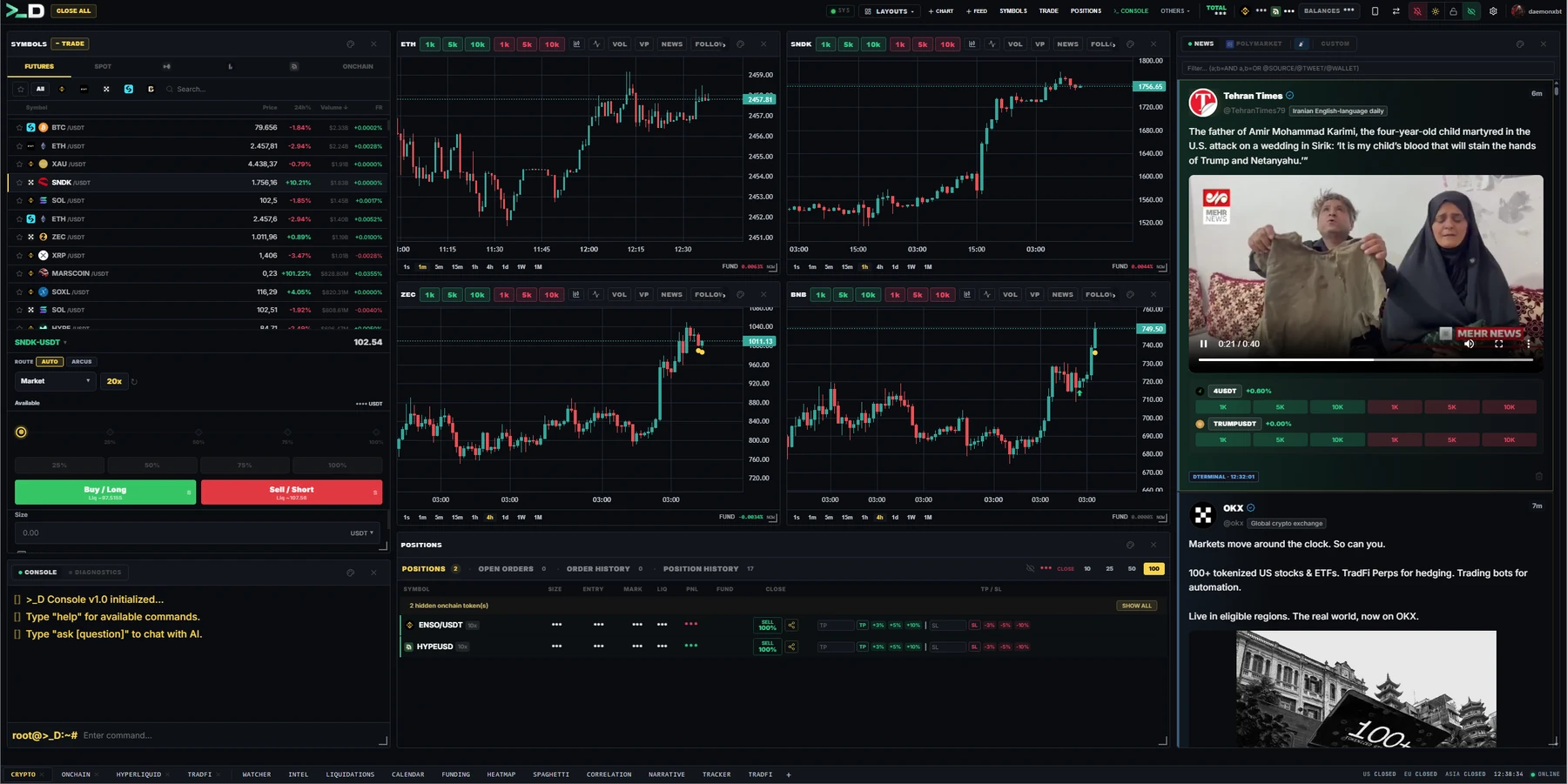
A professional trading terminal that unifies charts, news, positions, and execution into a single workspace. Futures across eight exchanges, and on-chain swaps on Solana, Ethereum, Base, BSC and Robinhood.
One window: symbol list, chart, order book, positions and the live news feed — with the command console along the bottom and twelve workspace tabs across the footer. Drag any panel where you want it, save the layout, and keep a separate workspace per strategy.
Each one below is a full screen of the terminal, not a mockup. They live in the same window — switch between them without losing a layout, a chart or a position.
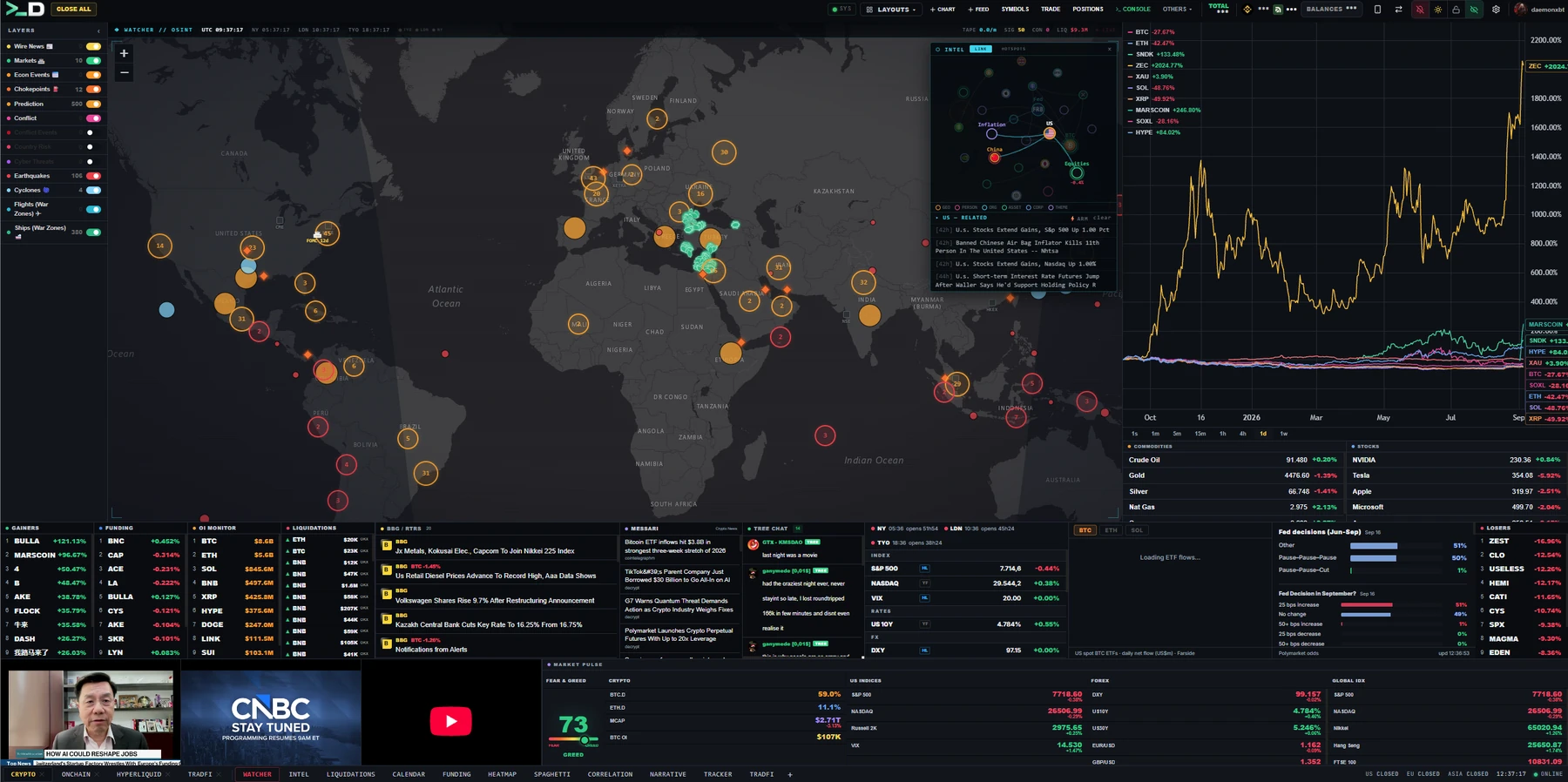
Conflict zones, earthquakes, cyclones, shipping chokepoints and war-zone air traffic, drawn on one map and layered over the newswire. When a headline breaks, you see where it happened before you read where it happened.
Underneath the map sit the things that react first: gainers and losers, funding, open interest and the liquidation tape. The catalyst and the market's answer to it are on the same screen, so you are not alt-tabbing to find out whether anyone cared.

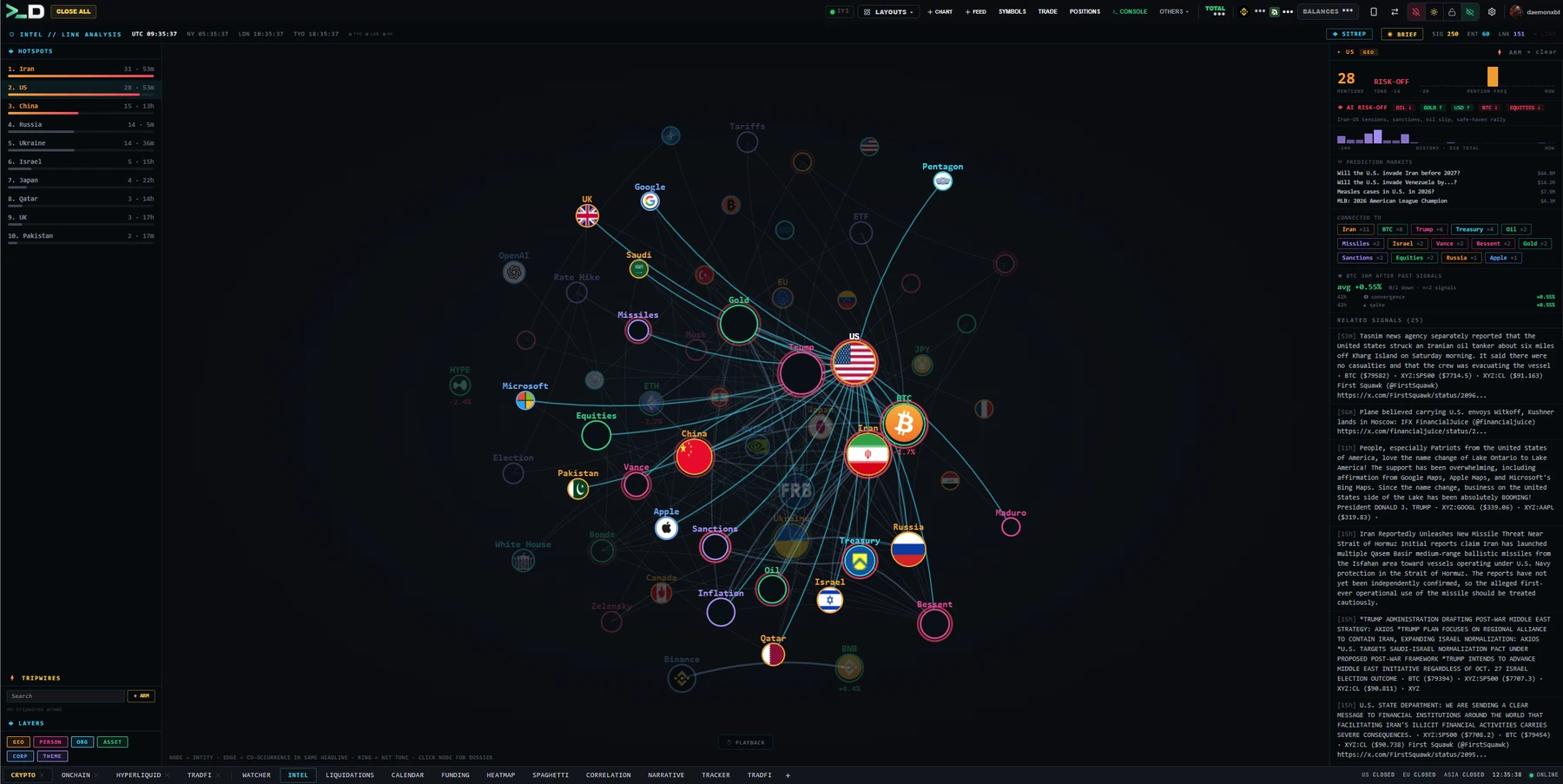
Every story is parsed into the entities it actually concerns — countries, companies, people, assets — and drawn as a graph of what is co-occurring right now. Reading a feed tells you what happened; reading the graph tells you what is clustering.
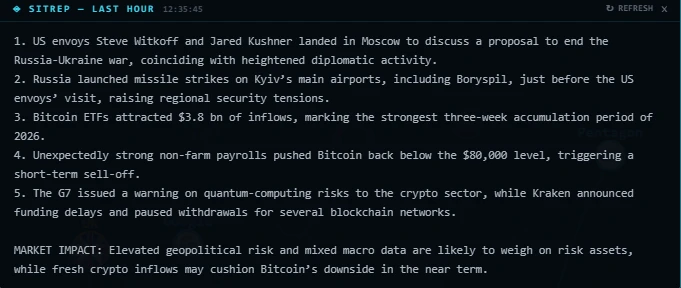
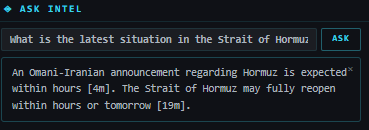
Hotspots rank by pressure so the crowded corner of the map is obvious. Tripwires fire on the combinations you arm, and when the picture is not obvious you can simply ask the panel what is driving a move and get an answer built from the same feed.


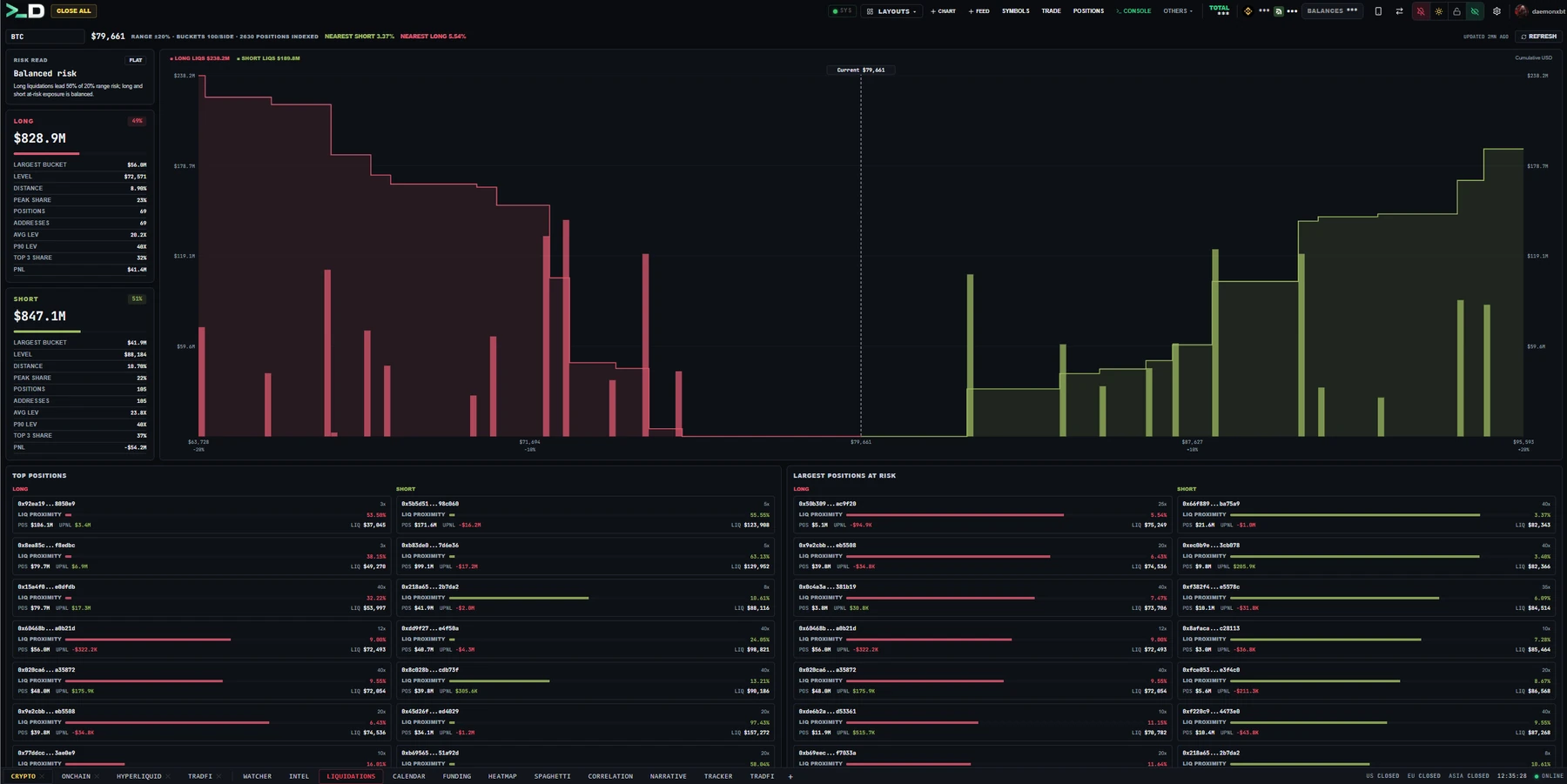
A live tape of forced closes across venues, sized so a real cascade looks like one. Below it, the map of resting liquidation levels — the prices where the next wave would start if the market walks into them.
The panel also reads the stress rather than only showing it: the 90th-percentile leverage in the sample, the median distance to liquidation and how concentrated the risk is in the top three positions. Medians, not averages, because one whale otherwise writes the whole number.

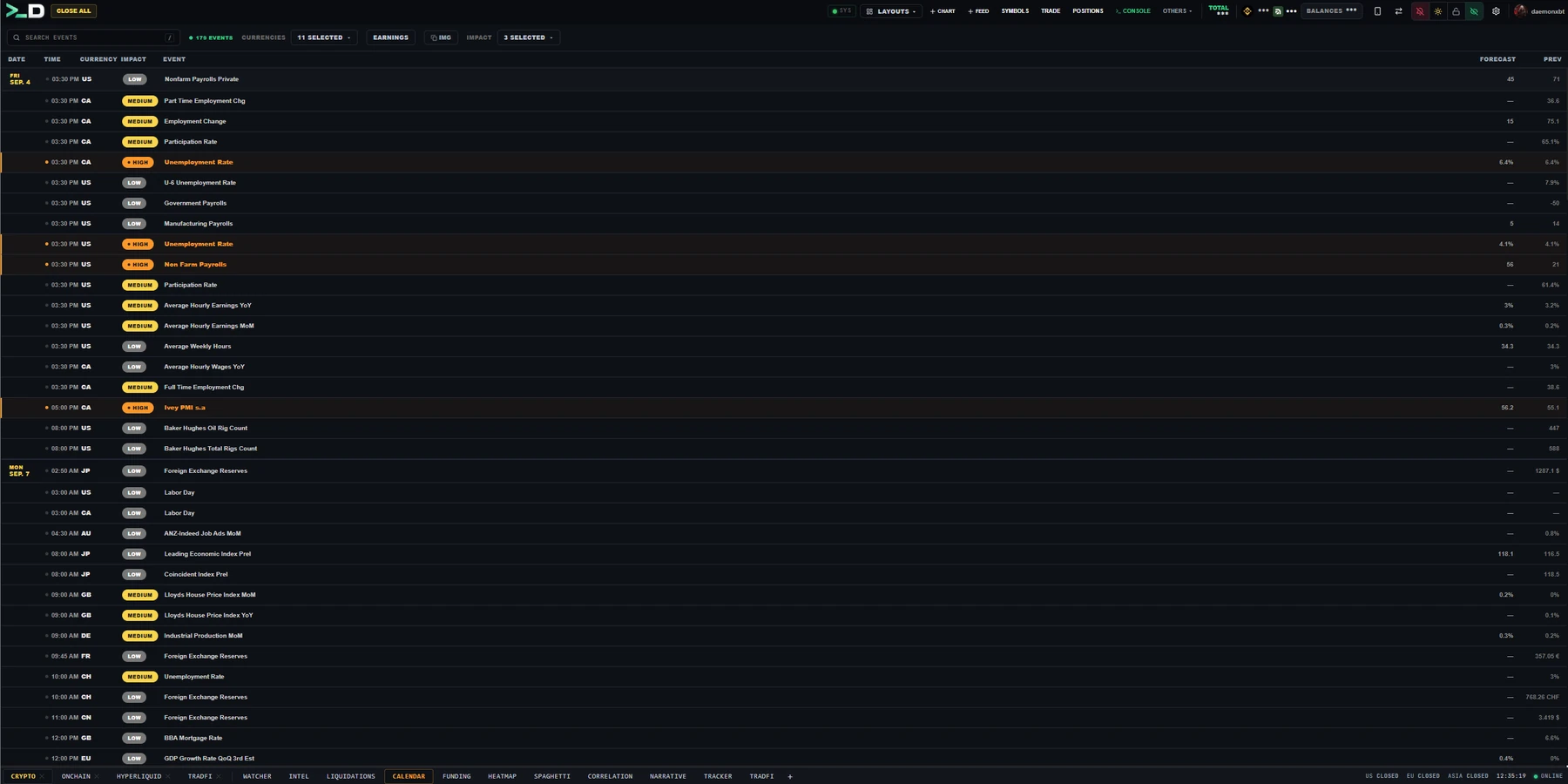
The economic calendar with the parts that matter to a trader kept in front: currency, forecast, previous print and an impact rating, filtered down to the releases you care about.
It collapses to a two-line card in a narrow pane, so the calendar can live in a thin column beside a chart instead of demanding half the screen.

Funding rates across every connected venue in one table, so the cost of holding a position is a number you look at rather than a number you discover on the next settlement.
Sorting by extreme funding is a positioning signal in itself: when one side is paying heavily to stay on, the crowded trade names itself.
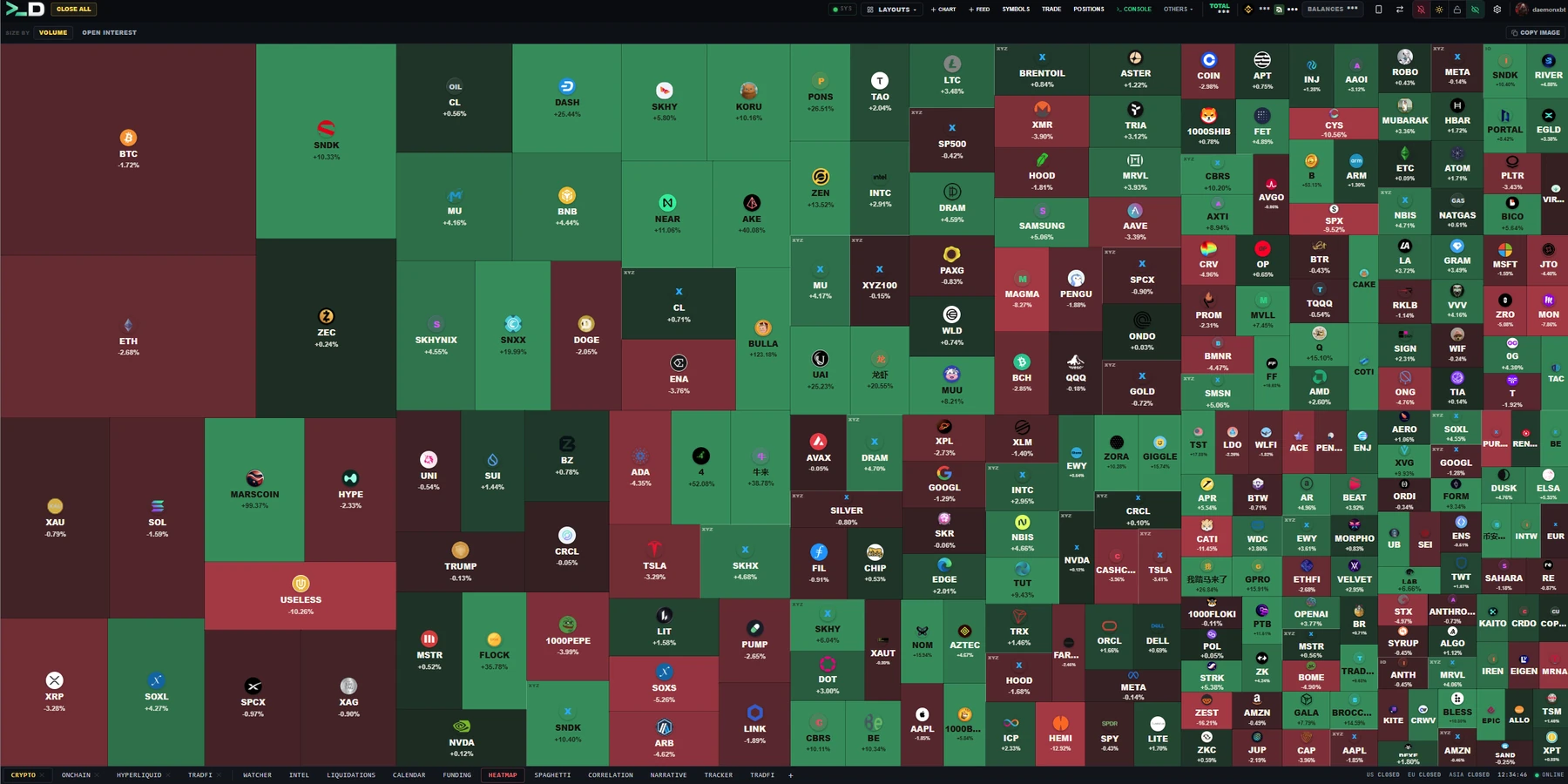
Every market sized by the measure you choose and coloured by move, so breadth is something you see instead of something you calculate.
Grouping by category separates a genuine sector rotation from three large caps dragging an index around.

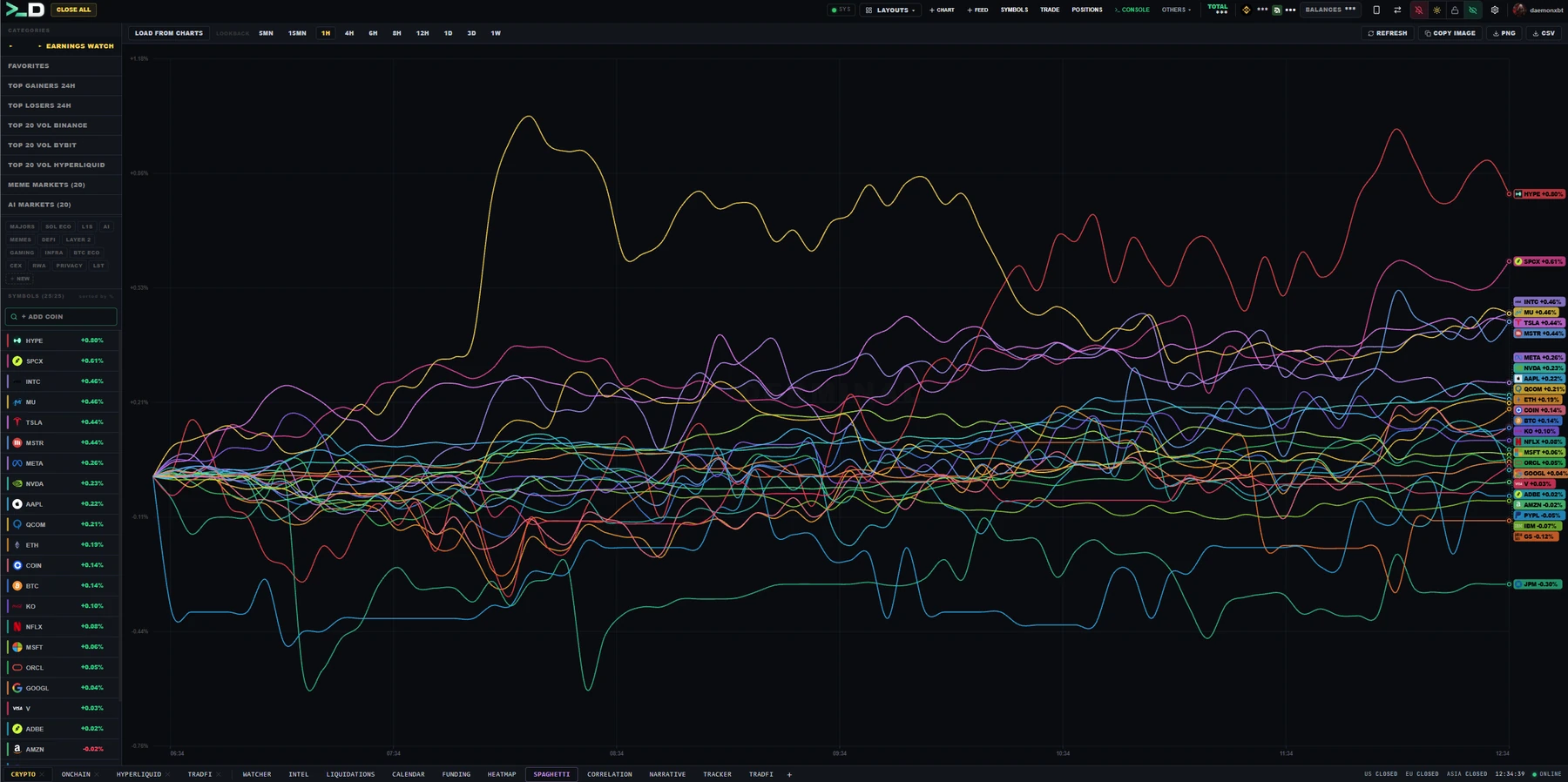
Every symbol rebased to a common start so the lines answer one question: which of these is actually outperforming, and since when.
Absolute prices hide this completely — two assets can look identical on separate charts and be twenty points apart once you put them on the same axis.

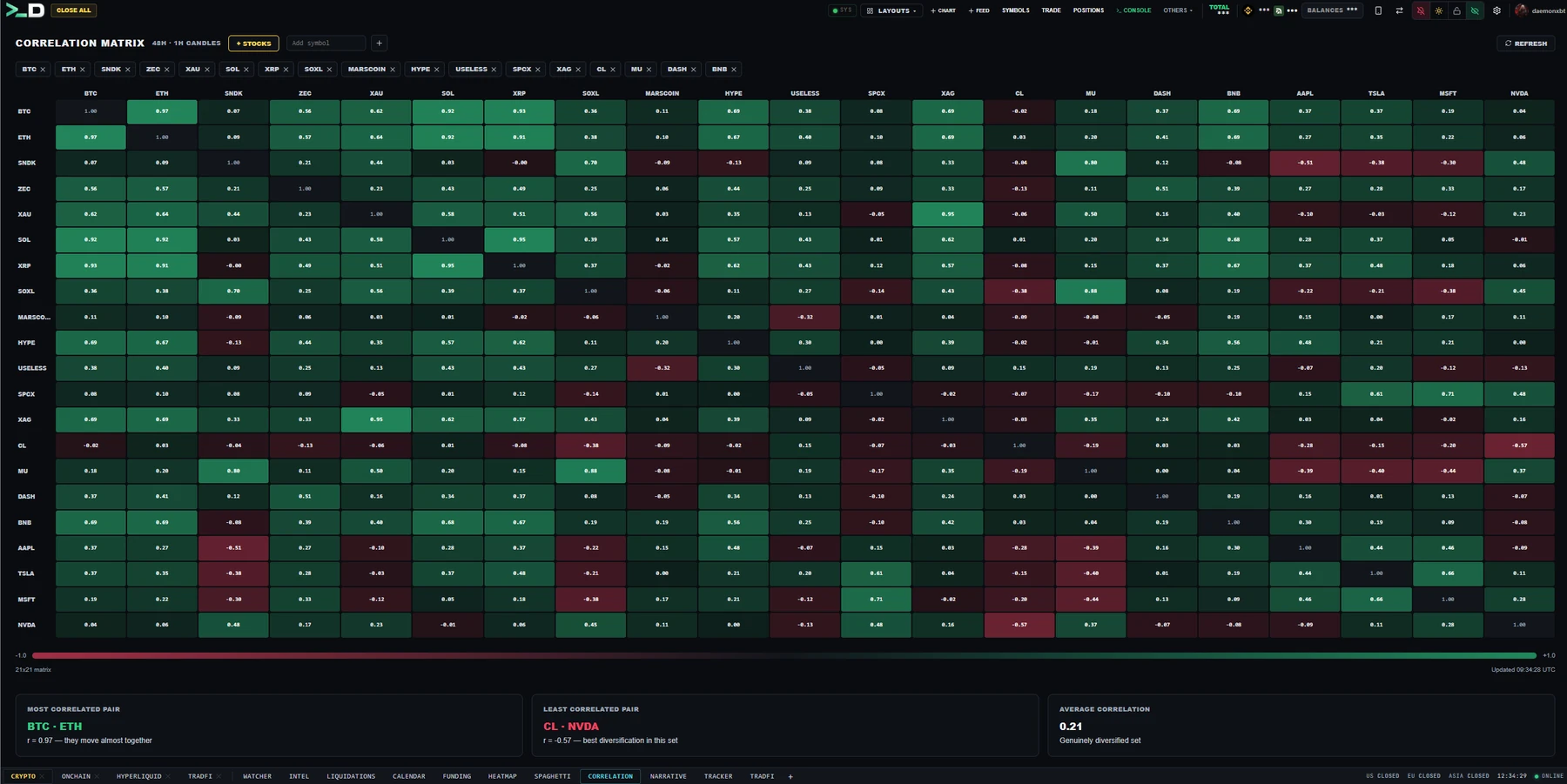
A correlation matrix over the window you pick, with the most and least correlated pairs called out and the average printed underneath.
It is the fastest way to find out that the four positions you thought were diversified are in practice one position held four times.

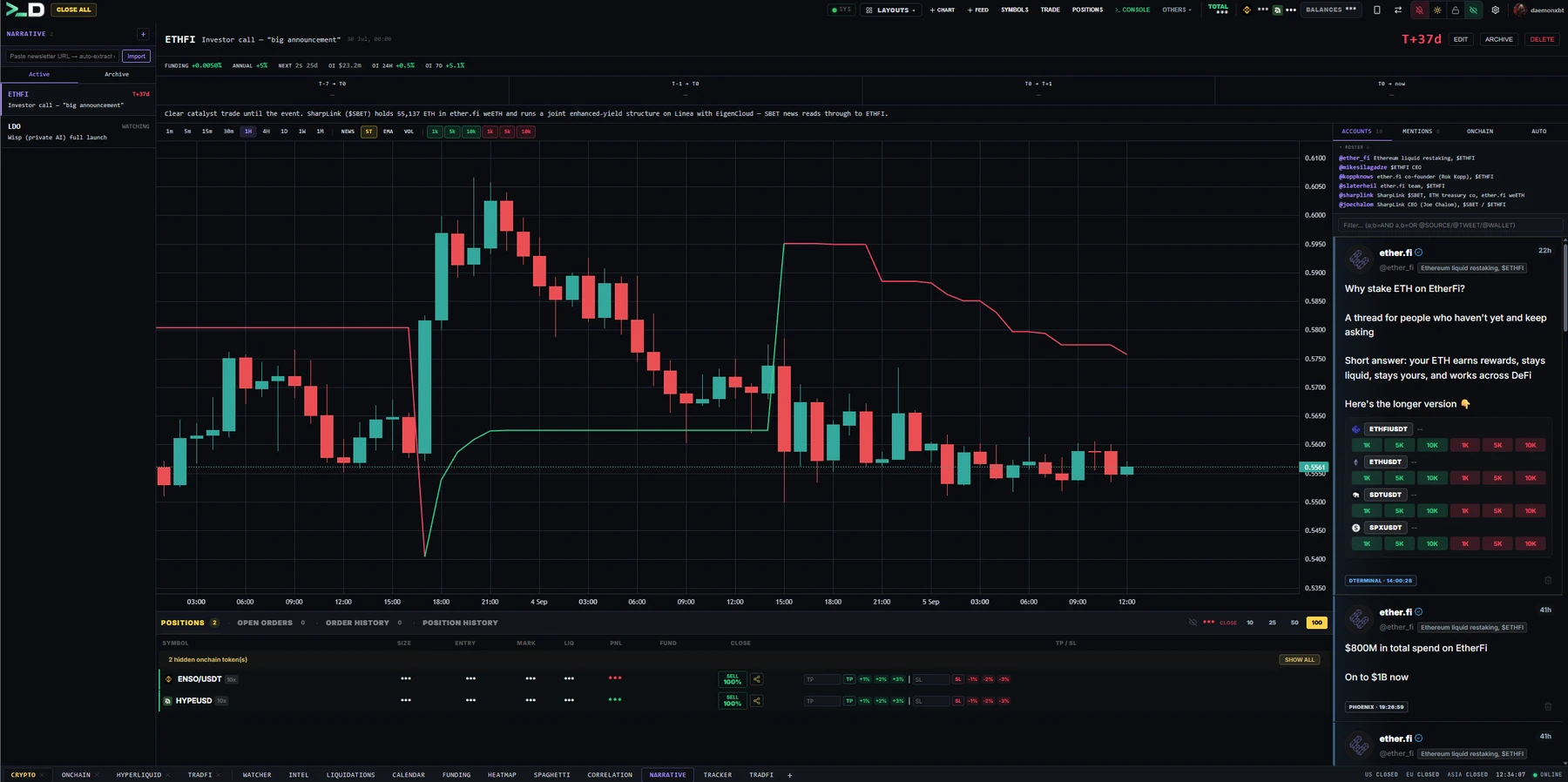
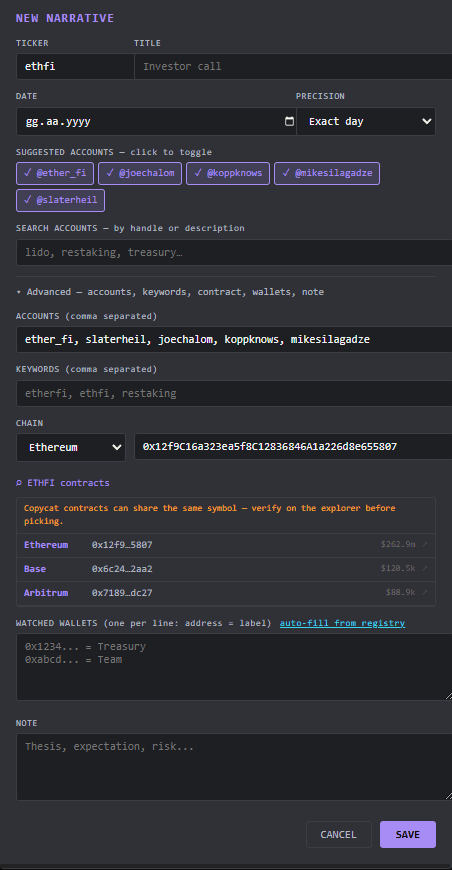
A roster of coins with the catalysts attached to each: mention counts over time, the chart, the feed items that caused the count to move, and the onchain activity underneath it.
The point is sequence. A mention spike that precedes the move is information; the same spike after the move is a crowd arriving late, and the panel keeps the two visibly apart.


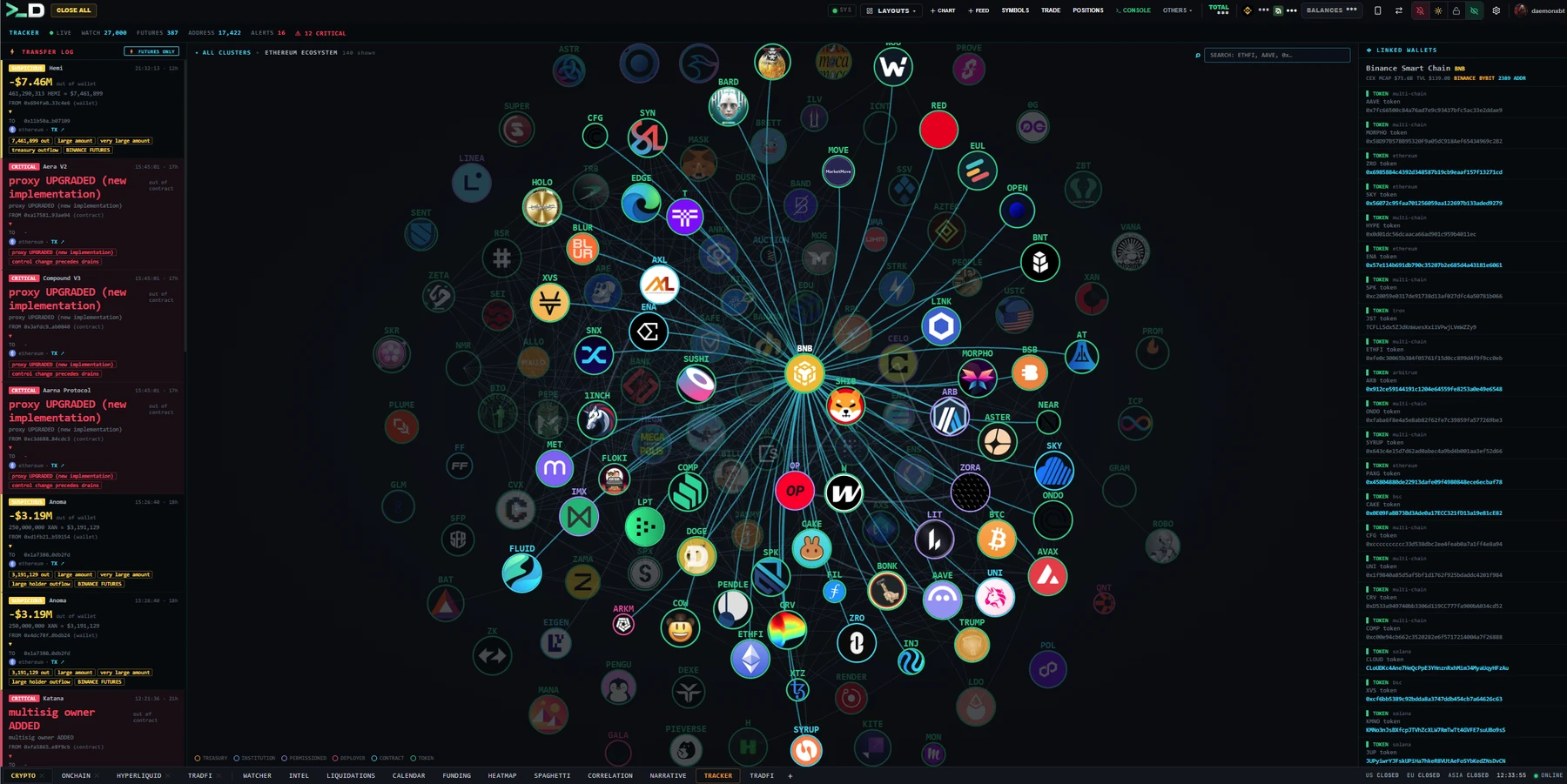
Named wallets and contracts monitored continuously, with separate alarm rules for each because a wallet moving funds and a contract changing state are not the same event.
It exists for one job: catching an anomaly on a listed perpetual early enough that the reaction is still tradeable rather than historical.
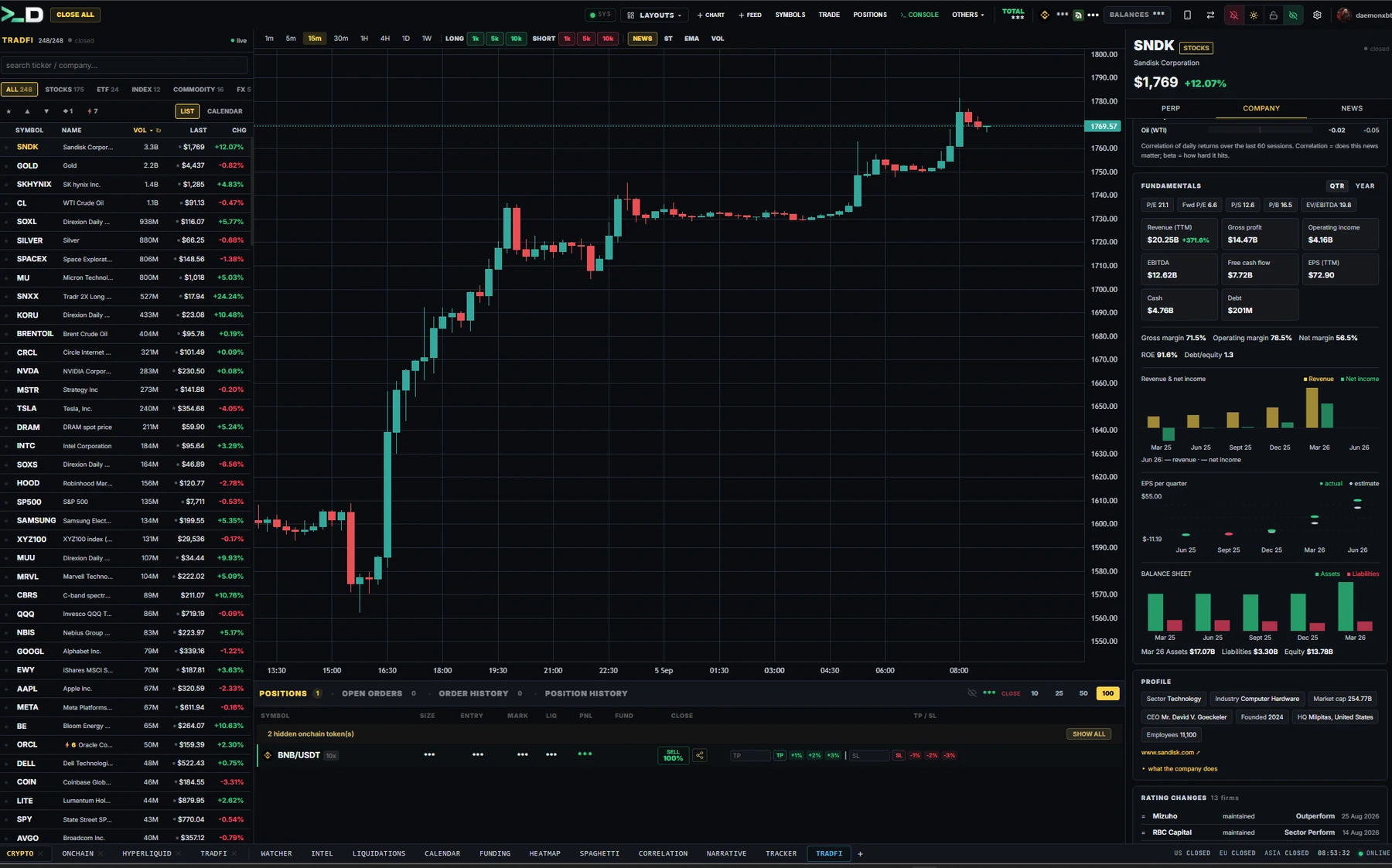
The tokenized-equity perpetual universe across every connected venue in one table — live quotes, funding and open interest, plus the earnings calendar for the names behind them.
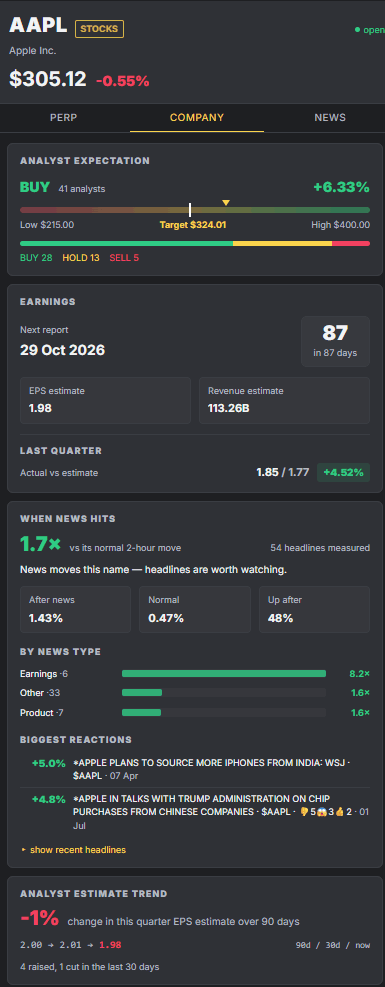
The fundamentals block sits underneath, so a position in an equity perp can be checked against the company's actual numbers without leaving the terminal.


The execution workspace: charts, order book, depth, positions and the order ticket, arranged as movable panels rather than a fixed layout you have to live with.
Eight venues route through the same ticket — market, limit, stop, take-profit, TWAP, scale, chase and swarm — with the required margin shown before you send, not after the exchange rejects you.

From sign-up to your first trade in under five minutes.
Discord, Google, X or an email address — one click, no form, no card. Your 3-day free trial starts the moment you sign in: full terminal, every exchange, every panel.
Add API keys for any of the eight supported exchanges. Connect your Solana/EVM wallets for on-chain trading.
Open charts, dock your news feed, relay channels, and execute. Use the visual interface or the CLI console — your choice.
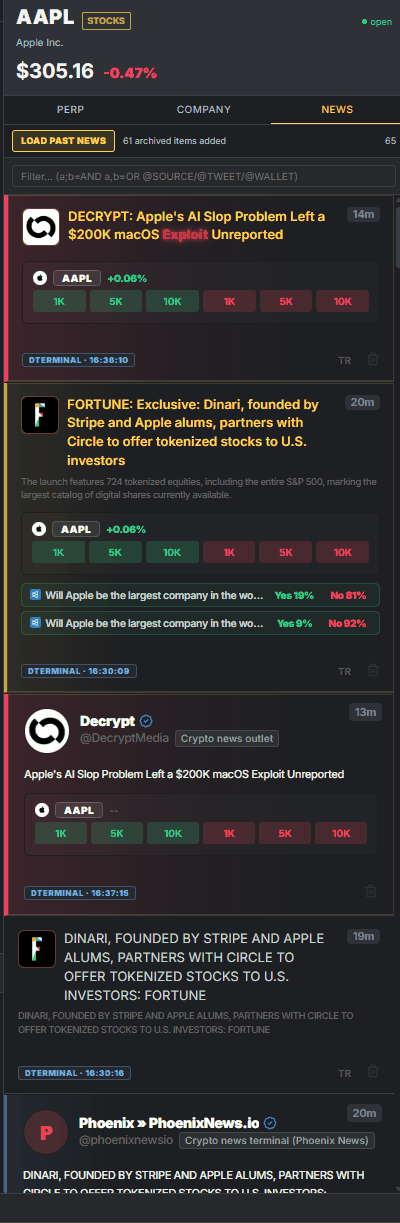
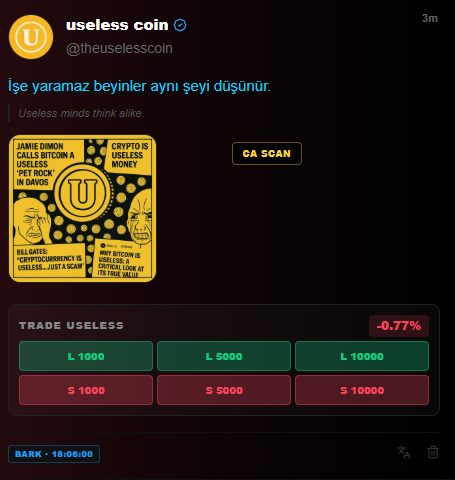
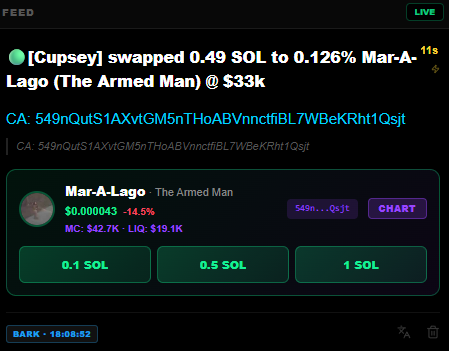
The news feed isn't just for reading. It's a trading interface. See a catalyst, click a token, and execute — all within D.Terminal.
Images in the feed are automatically scanned for contract addresses using AI vision. Tokens are validated against DexScreener with one-click trade buttons.
Foreign language posts are automatically translated so you never miss alpha from non-English sources. Works across all relay channels.
Click any detected token to instantly open its chart or trade it on-chain. From headline to position in seconds.
A CLI built into the terminal. Place orders, manage positions, and query data — keyboard only.
Not another charting tool. A complete trading operating system.
Orders go out over a persistent connection — the last measured round trip was about 330 ms from click to exchange acknowledgement. Positions, PnL and TP/SL updates stream over WebSocket, and stops can be dragged straight on the chart.
Charts, news, positions, orders, and console — all visible simultaneously. Customizable grid layouts with drag-and-drop panels and workspace saving.
CLI console for power users. Visual interface for everyone else. Keyboard shortcuts, hotkeys, and command aliases. D.Terminal adapts to you.
No tiers, no feature gates, no per-exchange add-ons. Every plan unlocks all eight exchanges, all twelve workspaces and every news source. Pick a term and the longer you commit, the less you pay.
Full terminal, every exchange, every panel. Sign in with Discord, Google, X or an email address and start immediately. No payment details until you decide.
Start Free TrialYour credentials are yours alone: keys are held encrypted against your account, used only for your orders, and never shared between users.
API keys are stored encrypted against your account and used only to sign your own orders. They are never shown to another user, never shared between accounts, and wallet connections sign locally — a private key never leaves your browser.
Every user session runs in complete isolation. Your data, positions, and configurations are separated at every layer of the stack.
All communication uses TLS/SSL encryption. WebSocket streams, REST API calls, and authentication — everything travels encrypted end-to-end.
Sign in with Discord, Google or X, or create an account with an email address and password — either way your 3-day free trial starts immediately, with no card and no waiting for approval. When the trial ends, pick a plan on the Plans section and you keep the same account, layouts and API keys.
Your exchange API keys are stored encrypted against your account and used only to place your own orders — never exposed to another user and never shared between accounts. Because the terminal runs in the browser, the keys live on our side rather than in the page; that is also why your account works from any device without re-entering them. Use trading-only keys with withdrawals disabled, and connect a wallet instead of pasting a private key wherever possible: wallet connections sign locally and the private key never leaves your browser.
D.Terminal supports futures trading on Binance, Bybit, OKX, Bitget, Blofin, Lighter, and Hyperliquid — including Hyperliquid's builder DEXes for tradfi perpetuals. For on-chain trading, you can swap tokens on Solana, Ethereum, Base, BSC and Robinhood directly from the terminal, and the Tracker watches Ethereum, Solana, BNB Chain, Base, Arbitrum and more.
Yes. There is a dedicated mobile layout — panels open one at a time with a tab bar, and the same account, workspaces and API keys follow you. Add it to your home screen (the phone icon in the terminal shows a QR code) and it runs full screen like an app, with keyword and price alerts pushed to the phone. The full multi-panel grid and the CLI console are still a desktop experience; the phone is built for watching the feed and managing positions.
A command-line interface built into the terminal. Type commands like market buy BTCUSDT 0.5 sl=95000 tp=105000 to place orders instantly. Supports aliases, leverage adjustment, position management and more.
Join the traders who execute before the market moves. One terminal, every tool you need.